



Introduction
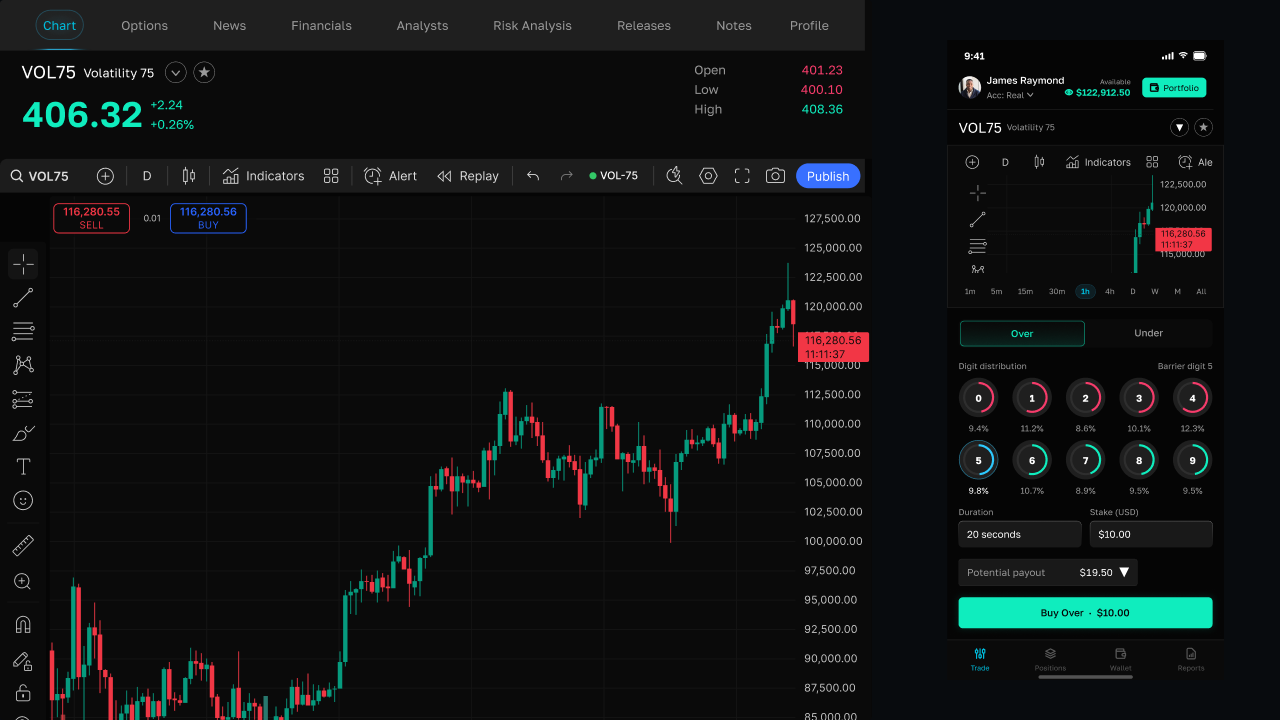
An Under digit contract wins when the last decimal digit of the exit price is less than the digit you predicted. It is the mirror of Over and uses the same last-digit rule at settlement.
How the last digit works
Only the rightmost decimal digit of the exit price counts. For 1,250.42, the last digit is 2.
Win condition
Last digit of exit price < your prediction
Loss condition
Last digit is equal to or greater than your prediction.
What to set on the order form
- Stake — $1 to $10,000
- Duration — 1 to 60 seconds
- Digit prediction — threshold digit 0–9
Win with prediction 5
Exit price: 1,250.31 → last digit 1
1 < 5 → Win
Loss with prediction 5
Exit price: 1,250.37 → last digit 7
7 is not less than 5 → Loss
Edge case: prediction 5, digit 5
Exit price: 1,250.45 → last digit 5
5 is not less than 5 → Loss
Choosing your prediction
Higher predictions (7, 8, 9) give more winning digits below them. Prediction 0 can never win on Under because no digit is less than zero.
Under vs. Over
Over needs the last digit above your pick; Under needs it below. For the same exit price and opposite predictions, one may win while the other loses — they are not simple opposites for every digit choice.
Think of Under as “finish with a smaller last digit than my number.”
Frequently asked questions
Is Under the opposite of Over with the same digit?

Can I pick 0 for Under?
What if the last digit equals my pick?
Related guides
 4 MIN
4 MINOver
Over digit contracts — predict the last decimal digit is greater than your chosen digit.
 4 MIN
4 MINDiffers
Differs digit contracts — win when the last digit is anything except the digit you pick.
 4 MIN
4 MINOdd
Odd digit contracts — win when the last decimal digit is 1, 3, 5, 7, or 9.